
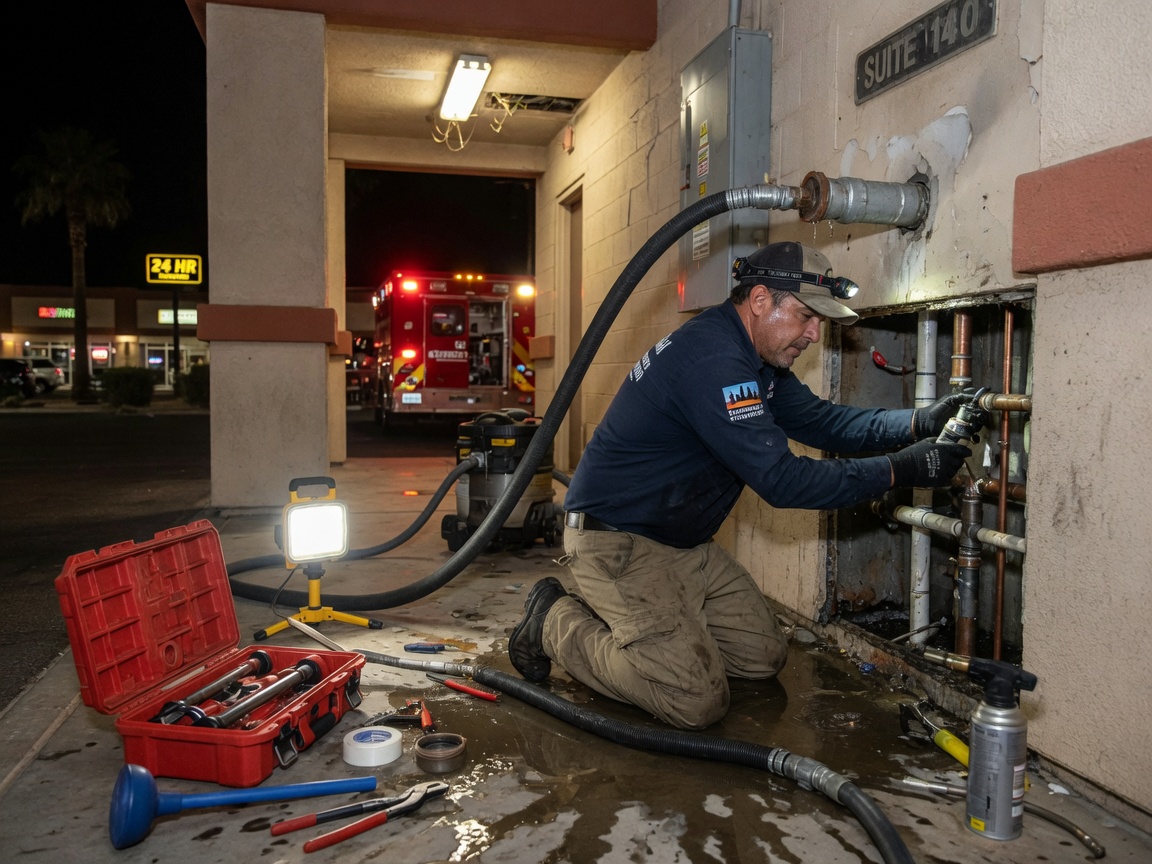
Phoenix commercial buildings face unique stresses from extreme summer heat that expands metal pipes and accelerates joint failures, especially in older stock found in Maryvale and South Mountain. Technicians routinely encounter corroded galvanized lines in structures built before the 1990s that crack when temperatures swing from 115 degrees to monsoon rains. Code requires backflow devices on commercial water lines in Maricopa County, and emergency calls often involve testing or replacing these after pressure drops during peak demand.
Restaurants and retail spaces near Camelback Mountain or Papago Park frequently call for grease trap overflows and clogged main lines that back up into kitchens during busy shifts. Hard water common throughout the valley leaves scale that narrows supply lines faster in commercial kitchens running constant hot water. Crews carry heavy-duty augers and hydro-jetting equipment sized for four-inch and larger commercial drains rather than residential tools.
Emergency response in areas like Arcadia and Camelback East often means navigating tight alley access or rooftop mechanical rooms where commercial water heaters sit exposed to direct sun. Technicians check for thermal expansion tanks missing on older installations, a common oversight that leads to burst lines when water pressure spikes. Work in Tempe and Mesa commercial strips follows the same pattern but adds travel time across the valley during rush hour.
Sewer camera inspections are standard on every commercial call because tree roots from desert landscaping and shifting soil around South Mountain properties crack clay and cast-iron lines. Immediate isolation of the affected zone prevents shutdown of entire buildings while repairs proceed.
Technician insight
In Phoenix the thing that catches most people out with commercial emergency plumbing is how fast scale builds in lines feeding kitchen equipment during 110-plus degree summers; older Maryvale buildings with original galvanized pipe fail first when monsoon pressure hits.
Restaurant Main Line Backup Near South Mountain
A South Mountain restaurant reported sewage backing into the kitchen during dinner rush. Camera inspection showed a cracked four-inch clay line where desert landscaping roots had entered. Crew isolated the section, replaced twelve feet with PVC, and hydro-jetted the remaining run to restore full flow before closing time.
Commercial Emergency Plumbing Services We Offer
✓Commercial Drain Jetting
High-pressure hydro-jetting clears grease, scale and debris from four-inch and larger lines common in Phoenix restaurants and offices without chemicals that violate local codes.
✓Emergency Commercial Pipe Repair
On-site soldering, press-fit or sectional replacement of copper and PVC lines damaged by heat expansion or age in Biltmore and Arcadia commercial properties.
✓Commercial Toilet and Urinal Repair
Rapid replacement of flush valves, seals and supply lines in high-use restrooms at venues near Chase Field and the Phoenix Zoo to stop ongoing water loss.
✓Backflow Preventer Emergency Service
Testing, repair and replacement of reduced-pressure backflow assemblies required by Maricopa County on commercial water services after pressure events.
✓Grease Trap Overflow Response
Same-day pumping and line clearing for restaurant grease traps in South Mountain and Maryvale that back up during peak summer service hours.
✓Commercial Water Heater Isolation
Emergency shutoff and bypass of leaking commercial tank or tankless units in retail spaces across Tempe and Mesa before full replacement can be scheduled.
Commercial Emergency Plumbing Cost in Phoenix, AZ
| Service | Typical Range | What Affects It |
|---|---|---|
| Commercial Drain Jetting | $350–$750 | Line length and grease load affect final cost |
| Emergency Pipe Repair | $400–$900 | Access difficulty and pipe material change price |
| Backflow Preventer Replacement | $550–$1,100 | Device size and permit requirements |
| Grease Trap Service Call | $300–$600 | Tank size and overflow severity |
Ranges are typical for Phoenix, AZ and confirmed with an exact written quote before any work starts.
How it works
- 1
Call Intake
Dispatch records building type, location in Phoenix or surrounding cities, and reported symptoms to send the correct equipment and crew size.
- 2
Site Assessment
Technician isolates the failure, checks building shutoffs and performs a quick camera or pressure test to determine scope before quoting.
- 3
Immediate Containment
Water is shut off or bypassed to protect inventory and flooring while the repair plan is confirmed with the business owner.
- 4
Repair and Verification
Work is completed, lines are pressure tested, and the system is returned to service with a written summary of findings.
Pricing
Upfront written quotes provided on site before repairs begin; final price depends on access, line size and time of call.